
Mox Diamonds vs. Actual Diamonds
What would $10,000 invested in March 1998 be worth today? Mox Diamond trading cards, the S&P 500 and natural diamonds through November 5, 2026.
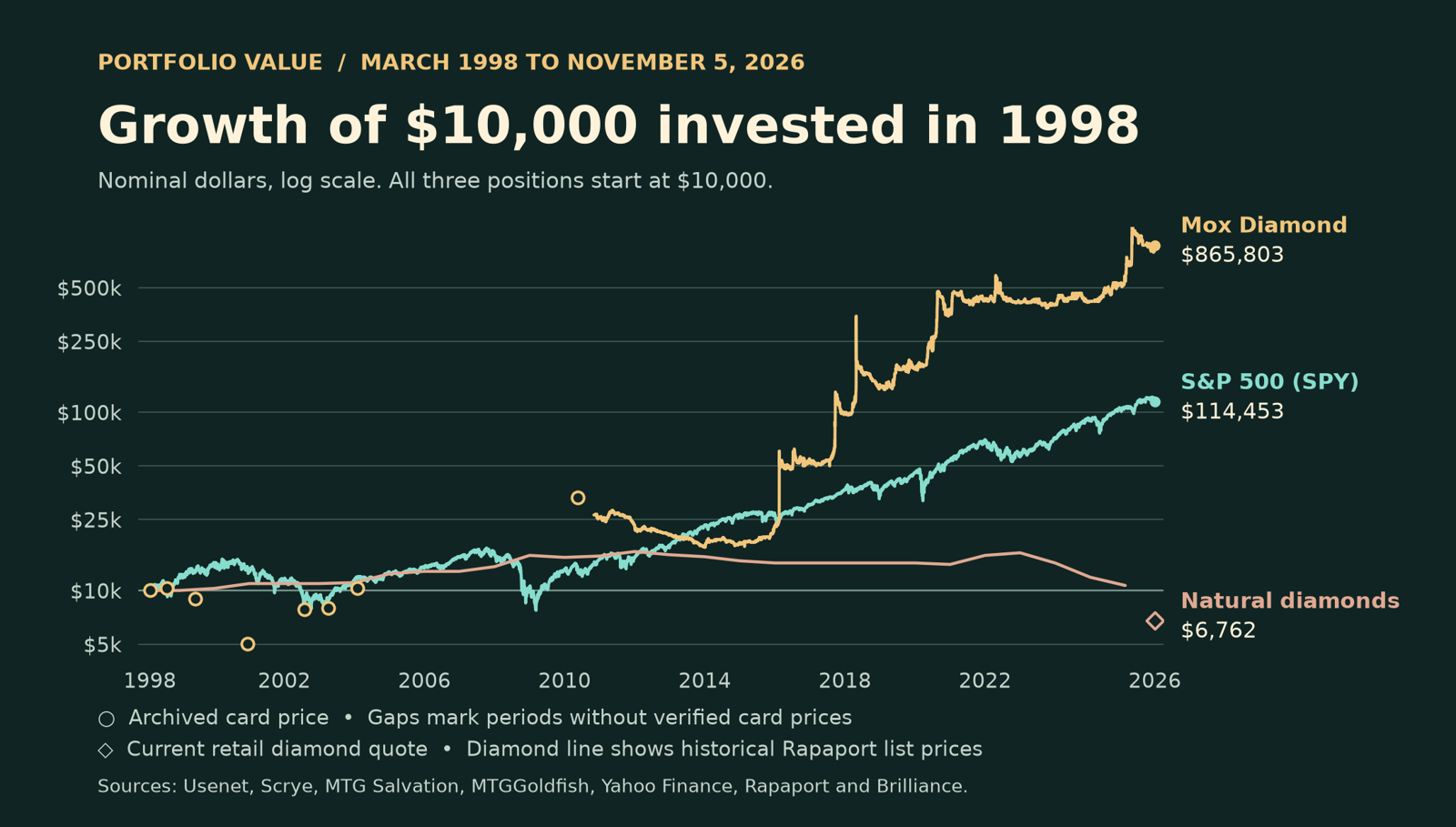
It's 1998. If you had put $10,000 into Mox Diamond Magic: The Gathering trading cards, an S&P 500 index fund, or "investment grade" natural diamonds, what would each investment be worth today? 
As of November 5, 2026, the Mox Diamonds would have been worth $865,803  at the quoted card price, the S&P 500 fund $114,453
 with dividends reinvested, and the natural diamond position $6,762
 at current retail asking prices.
Historical comparison
The card position includes $10 of uninvested cash. The stock position reinvests dividends. The diamond position tracks a price list normalized to $10,000.
| Position | End value | Multiple | CAGR |
|---|---|---|---|
| Mox Diamond · original Stronghold printing | $865,803 | 86.58× | 16.83% |
| S&P 500 · SPY with dividends reinvested | $114,453 | 11.45× | 8.87% |
| Natural diamonds · one-carat F/VVS2 retail quote | $6,762 | 0.68× | −1.36% |
Returns are nominal. The compound annual growth rate (CAGR) covers approximately 28.7 years. The SPY result reflects fund expenses. Figures exclude taxes, trading costs and the costs of holding physical assets.
The card and the entry price
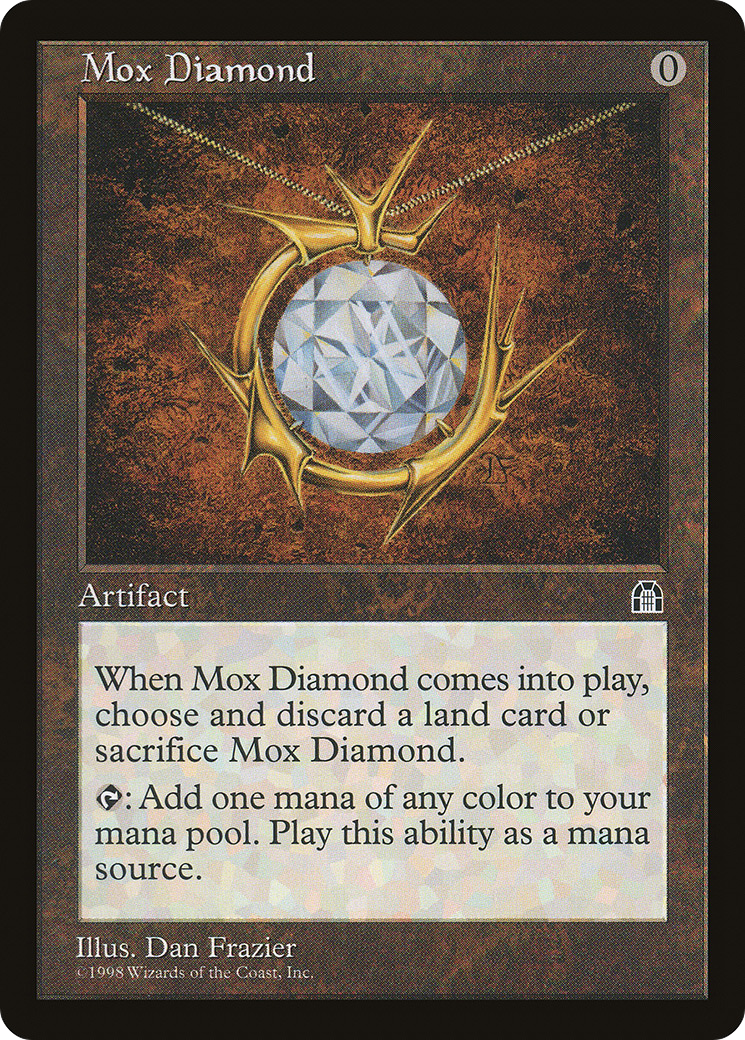
Magic: The Gathering is a trading card game. Players build decks and use mana to cast spells. Land cards are the usual source of mana, and players can normally play only one land per turn. Mox Diamond, first printed in Stronghold on March 2, 1998, costs zero mana to cast. To put it into play, you discard a land card from your hand. Once in play, it can produce one mana of any color, including on the first turn.  That lets players cast spells earlier at the cost of a land card they could have played later.
A March 17, 1998 trade list valued two mint or near-mint copies at $15 each. Other launch-month auctions showed bids of $15 and $16. An August auction recorded three copies sold at $15.50 each. These observations support $15 as an estimate for a small purchase. The calculation assumes 666 copies could be sourced at that price.
March 21 auction · March 11 auction
The chart uses dated price observations for the early years. Usenet sellers asked $13.50 in June 1999 and $7.50 in December 2000. Scrye reported median prices of $11.75 in July/August 2002, $12 in April 2003, and $15.50 in February 2004. A May 2010 forum price guide recorded a $49.99 Star City Games quote. The daily MTGGoldfish series begins in November 2010.
1999 Usenet listing · 2000 Usenet listing · Scrye #52 · Scrye #58 · Scrye #68 · May 2010 price guide
At $15 per card, $10,000 buys 666 copies for $9,990, leaving $10 in cash.
Valuation and execution
MTGGoldfish quoted $1,299.99 per copy on November 5, 2026. The estimated portfolio value is the quote multiplied by the number of cards, plus any residual cash. To match SPY, sale proceeds plus residual cash would have to equal $114,453. The table holds the November 5 quote fixed. “Exit per card” is the sale price needed to match SPY.
MTGGoldfish tabletop price history
| Entry per card | Copies | Ending value | Exit per card |
|---|---|---|---|
| $15 | 666 | $865,803 | $171.84 |
| $20 | 500 | $649,995 | $228.91 |
| $25 | 400 | $519,996 | $286.13 |
At the base entry price, the break-even sale price is about 87% below the quoted price, before fees. That gap measures how much room the modeled position has to absorb a lower sale price. It gives no estimate of market depth or how long a sale would take. Card condition, dealer spreads and the effect of bringing hundreds of copies to market all matter. There is also selection bias: the analysis picks one collectible after observing its performance, while SPY tracked a diversified index throughout the period.
Benchmark construction
S&P 500. SPY was already trading in 1998. The return uses the ratio of its dividend-adjusted closing prices on March 2, 1998 and November 5, 2026, approximately $64.04 and $733.00 in the same series. The calculation uses the unrounded prices.
State Street fund profile · SPY historical prices
Natural diamonds. “Investment-grade” describes a sales category. GIA grades individual stones on attributes such as color, clarity, cut and carat weight. This comparison uses a 1.00-carat round natural diamond with F color and VVS2 clarity. Rapaport quoted $7,500 per carat at both year-end 1997 and year-end 1998. Its published annual series gives $8,000 at year-end 2025, the last point on the historical line.
GIA grading reports · Rapaport annual price table
On November 5, 2026, Brilliance listed four in-stock, GIA-certified natural stones matching that weight, shape, color and clarity at $4,756, $4,973, $5,170 and $5,195. The median asking price was $5,071.50. Scaling the $7,500 entry benchmark to $10,000 gives a current value of $6,762. The grade has held up better than the investment. One whole stone bought at the entry benchmark plus $2,500 held in cash would be worth $7,572 at the same mark. The chart shows the retail quote separately from the Rapaport series. Resale proceeds depend on what a buyer bids for the stone.
Quote 1 · Quote 2 · Quote 3 · Quote 4
What if you bought the other 43 rares?
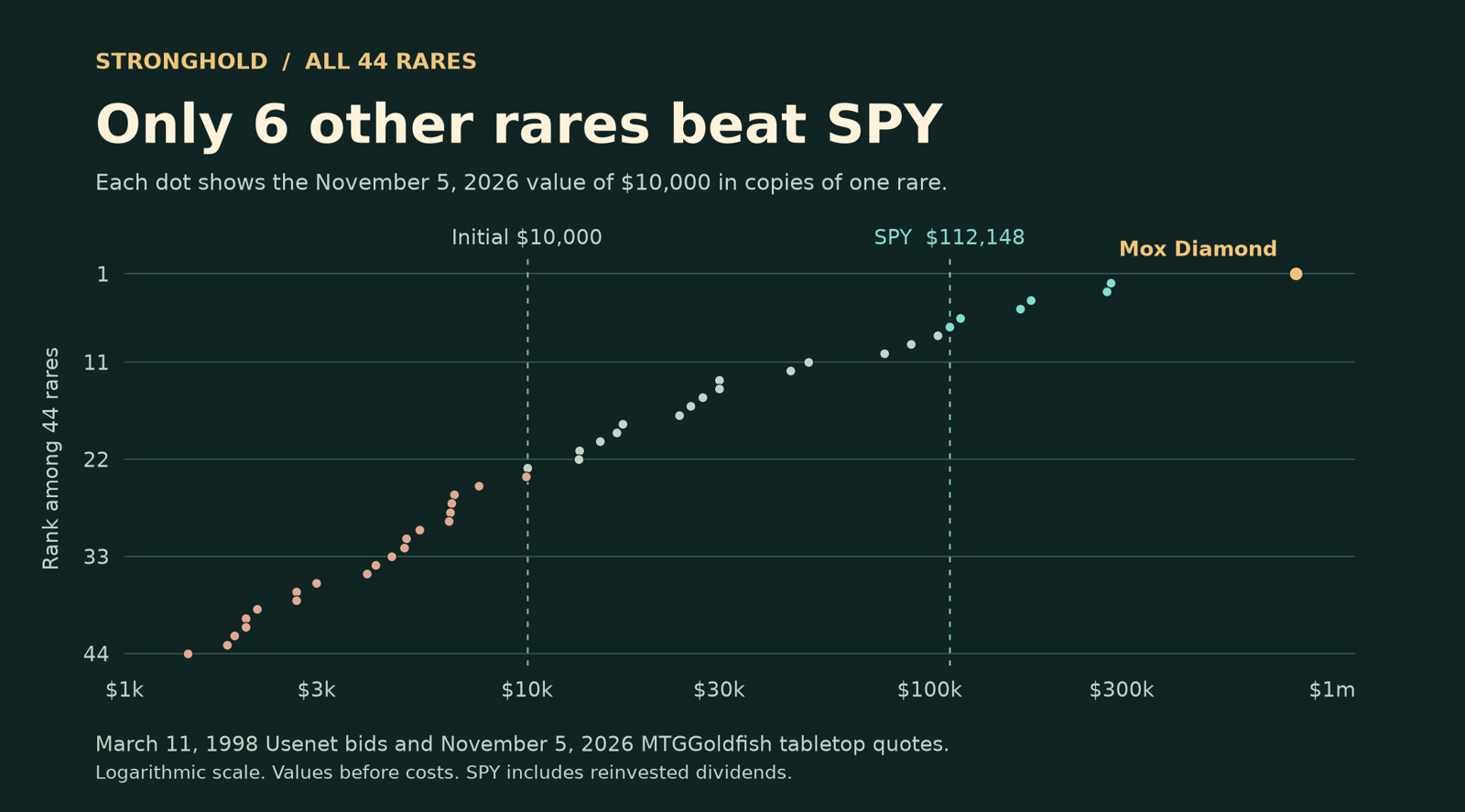
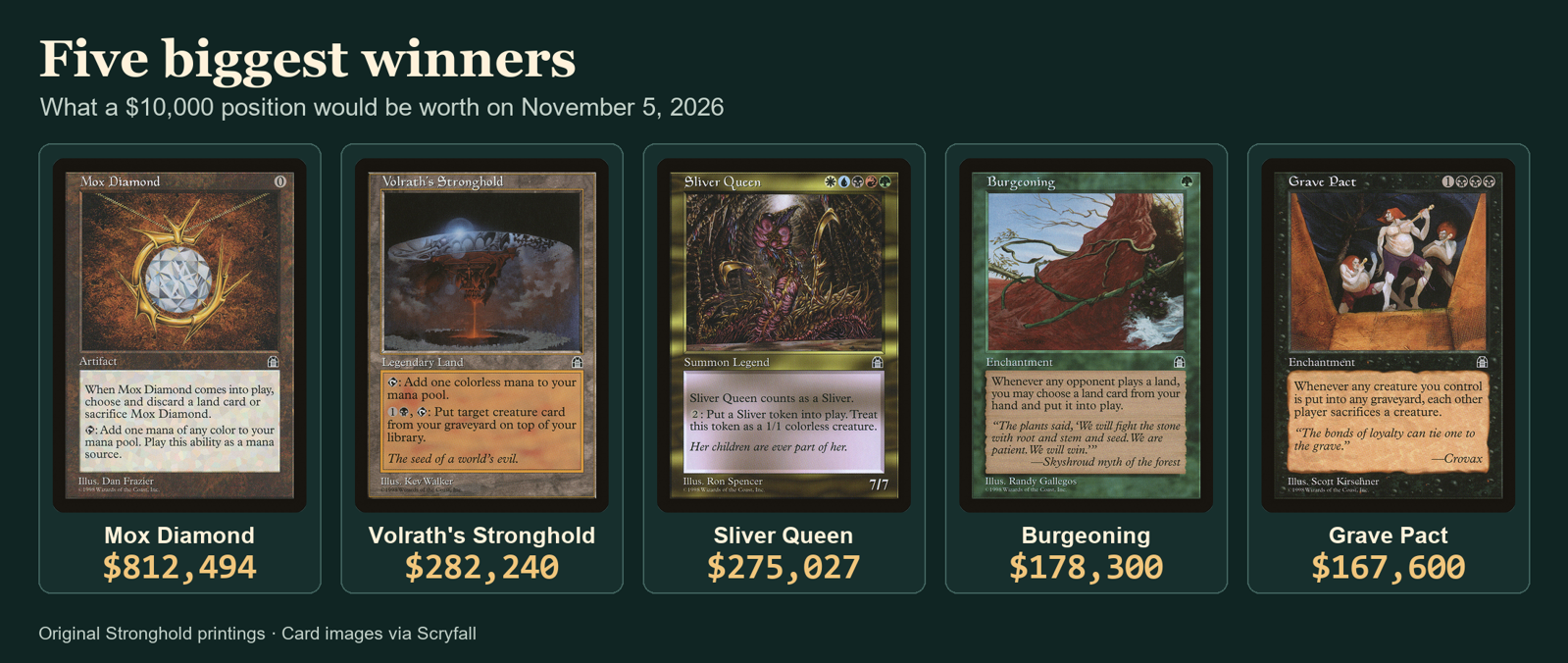
The median Stronghold rare excluding Mox Diamond turned $10,000 into $10,000 in nominal dollars. Twenty-one of the 43 fell below their starting bids, and six beat SPY. The best of the other rares were Volrath’s Stronghold ($282,240) and Sliver Queen ($275,027).
One March 11, 1998 Usenet auction listed a bid for every rare in the set.  I used those bids and MTGGoldfish’s November 5, 2026 tabletop quotes for the original Stronghold printings. Each card’s ending value is $10,000 multiplied by its quote divided by its bid. These are marks before costs. The auction records show bids for individual copies, and actual prices for buying or selling a large position could differ.
March 11 auction · MTGGoldfish Stronghold prices · SPY adjusted prices
| $10,000 invested on March 11, 1998 | End value |
|---|---|
| Median rare excluding Mox Diamond | $10,000 |
| Equal-dollar basket of the other 43 rares | $42,223 |
| Equal-dollar basket of all 44 rares | $59,729 |
| SPY, dividends reinvested | $112,148 |
| Mox Diamond alone at the auction’s $16 bid | $812,494 |
The baskets divide the starting money equally by card name. Buying whole copies and keeping the leftover cash would put the basket of 43 at $42,038. The SPY comparison here starts on the auction date, nine days after the release-date comparison above. Hermit Druid ends at $112,200, just $52 ahead of SPY on the auction-date comparison and below SPY on the release-date comparison.
All 44 prices and returns
| Rank and card | 1998 bid → 2026 quote | End value |
|---|---|---|
| 1. Mox Diamond | $16.00 → $1,299.99 | $812,494 |
| 2. Volrath's Stronghold | $5.00 → $141.12 | $282,240 |
| 3. Sliver Queen | $11.00 → $302.53 | $275,027 |
| 4. Burgeoning | $2.00 → $35.66 | $178,300 |
| 5. Grave Pact | $2.00 → $33.52 | $167,600 |
| 6. Dream Halls | $3.00 → $35.79 | $119,300 |
| 7. Hermit Druid | $1.00 → $11.22 | $112,200 |
| 8. Mortuary | $1.75 → $18.30 | $104,571 |
| 9. Horn of Greed | $2.00 → $17.99 | $89,950 |
| 10. Awakening | $1.00 → $7.73 | $77,300 |
| 11. Volrath's Shapeshifter | $3.00 → $15.01 | $50,033 |
| 12. Ensnaring Bridge | $3.00 → $13.55 | $45,167 |
| 13. Jinxed Ring | $1.00 → $3.00 | $30,000 |
| 14. Shaman en-Kor | $2.00 → $6.00 | $30,000 |
| 15. Thalakos Deceiver | $1.50 → $4.09 | $27,267 |
| 16. Intruder Alarm | $2.50 → $6.37 | $25,480 |
| 17. Hidden Retreat | $1.00 → $2.39 | $23,900 |
| 18. Ruination | $3.00 → $5.18 | $17,267 |
| 19. Soltari Champion | $2.00 → $3.34 | $16,700 |
| 20. Reins of Power | $2.50 → $3.79 | $15,160 |
| 21. Sacred Ground | $3.00 → $4.05 | $13,500 |
| 22. Mogg Infestation | $2.50 → $3.36 | $13,440 |
| 23. Crovax the Cursed | $1.00 → $1.00 | $10,000 |
| 24. Invasion Plans | $1.50 → $1.49 | $9,933 |
| 25. Evacuation | $2.00 → $1.52 | $7,600 |
| 26. Stronghold Assassin | $2.00 → $1.32 | $6,600 |
| 27. Portcullis | $3.00 → $1.95 | $6,500 |
| 28. Shard Phoenix | $2.50 → $1.61 | $6,440 |
| 29. Rolling Stones | $2.00 → $1.28 | $6,400 |
| 30. Sword of the Chosen | $1.00 → $0.54 | $5,400 |
| 31. Skeleton Scavengers | $1.00 → $0.50 | $5,000 |
| 32. Silver Wyvern | $2.00 → $0.99 | $4,950 |
| 33. Spitting Hydra | $1.00 → $0.46 | $4,600 |
| 34. Spike Breeder | $1.00 → $0.42 | $4,200 |
| 35. Amok | $1.00 → $0.40 | $4,000 |
| 36. Carnassid | $1.50 → $0.45 | $3,000 |
| 37. Flowstone Mauler | $1.50 → $0.40 | $2,667 |
| 38. Mindwarper | $1.50 → $0.40 | $2,667 |
| 39. Warrior Angel | $3.00 → $0.64 | $2,133 |
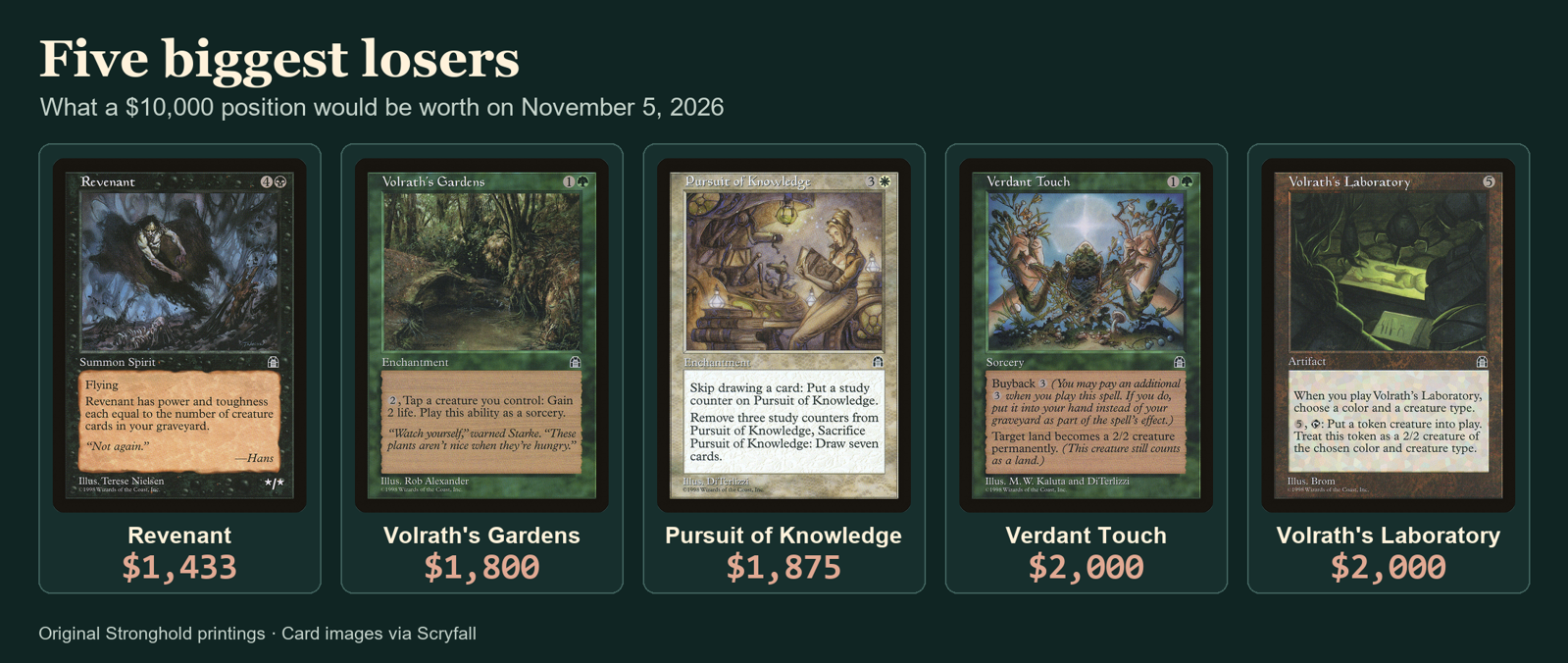
| 40. Verdant Touch | $2.50 → $0.50 | $2,000 |
| 41. Volrath's Laboratory | $2.50 → $0.50 | $2,000 |
| 42. Pursuit of Knowledge | $4.00 → $0.75 | $1,875 |
| 43. Volrath's Gardens | $2.50 → $0.45 | $1,800 |
| 44. Revenant | $3.00 → $0.43 | $1,433 |
The winners and losers
Comments
Your comments awaiting moderation
Only you and moderators can see these until they are approved.
No comments yet.
Log In or Sign Up to comment.