
Mox Diamond vs. Actual Diamonds
What if you’d put $10,000 into Stronghold Mox Diamonds in 1998? A historical comparison with natural diamonds and the S&P 500.
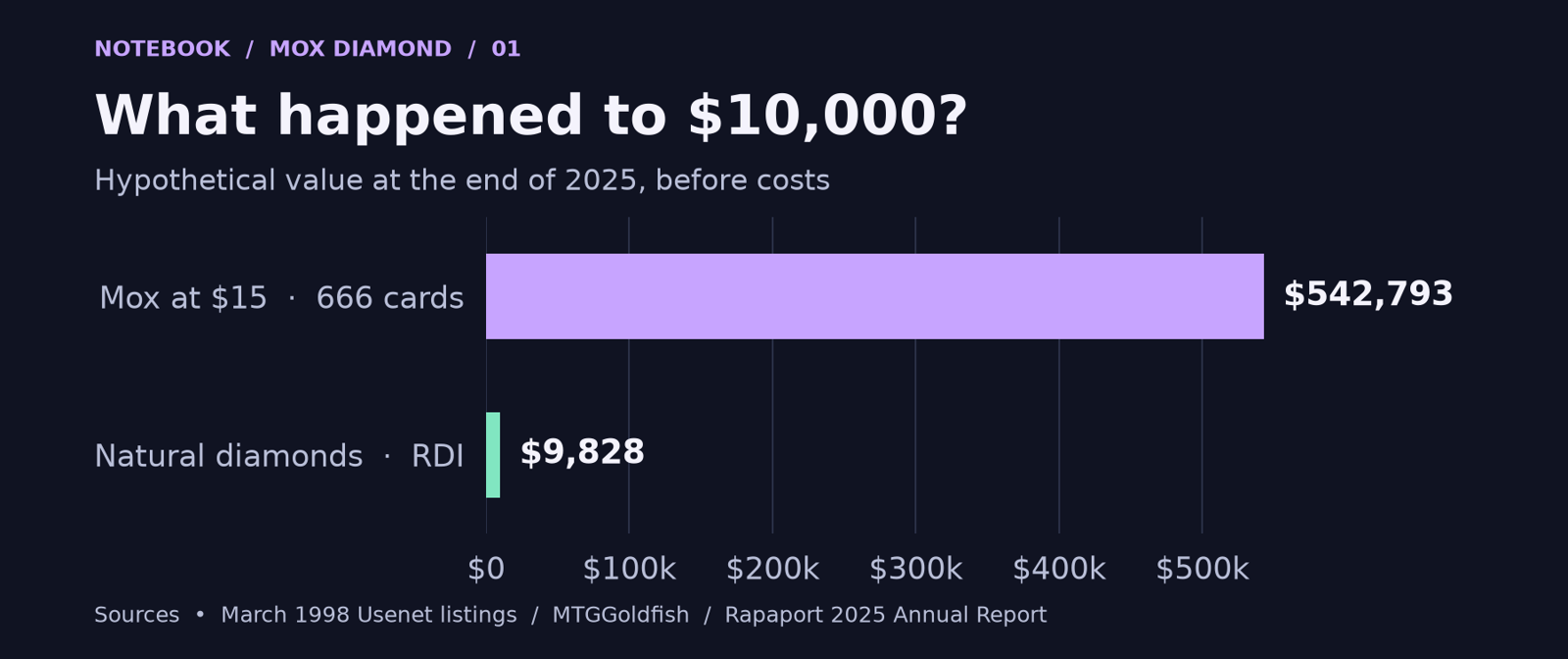
What if you’d spent $10,000 on Magic: The Gathering cards instead of actual diamonds? At my best launch-month estimate of $15 per Stronghold Mox Diamond, you could have bought 666 copies and kept $10 in cash. Marked at the December 31, 2025 tabletop quote, the pile and cash would have been worth $542,793. The natural-diamond benchmark would have ended at $9,828. MTGGoldfish · Rapaport’s 2025 price report
What $10,000 buys
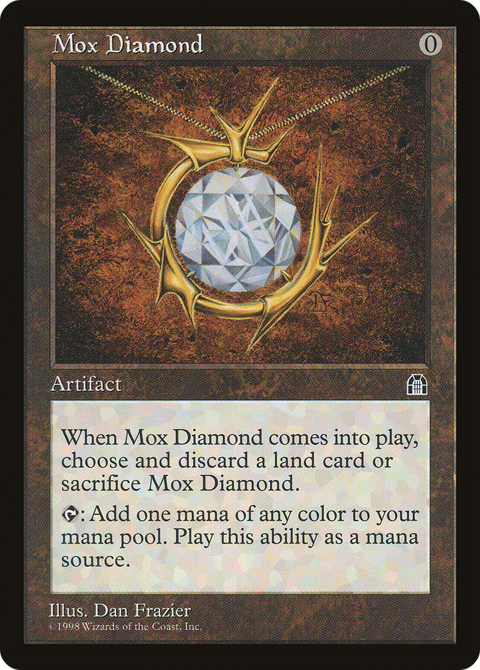
I used $15 per card as a working estimate for March 1998. A March 17 trade list valued two mint or near-mint copies at $15 each. Two March auctions showed bids of $15 and $16, and sellers advertised buyouts of $20 and $25. An August auction marked three copies sold at $15.50 each, including one French copy. Buying 666 copies at the same price is the thought experiment. March 17 trade list · March 11 auction · March 21 auction · March 28 auction · August auction results
For actual diamonds I used Rapaport’s one-carat round natural-diamond index (RDI), a price-list benchmark that averages 25 color and clarity combinations. I scaled its December 1997 reading of 81.5 to $10,000 and applied the change to 80.1 at the end of 2025. Using December 1998 as the starting point gives $9,889. A specific stone would have its own grade, purchase markup, and resale spread. Rapaport round-diamond table · How Rapaport calculates RDI
Between launch and the tracker
Scrye’s Stronghold price guides put the median at $11.75 in July/August 2002, $12.00 in April 2003, and $15.50 in February 2004. These are snapshots from the magazine’s price survey. They give us a few points in the long gap before MTGGoldfish starts tracking the card. Scrye #52 · Scrye #58 · Scrye #68
The stock-market comparison
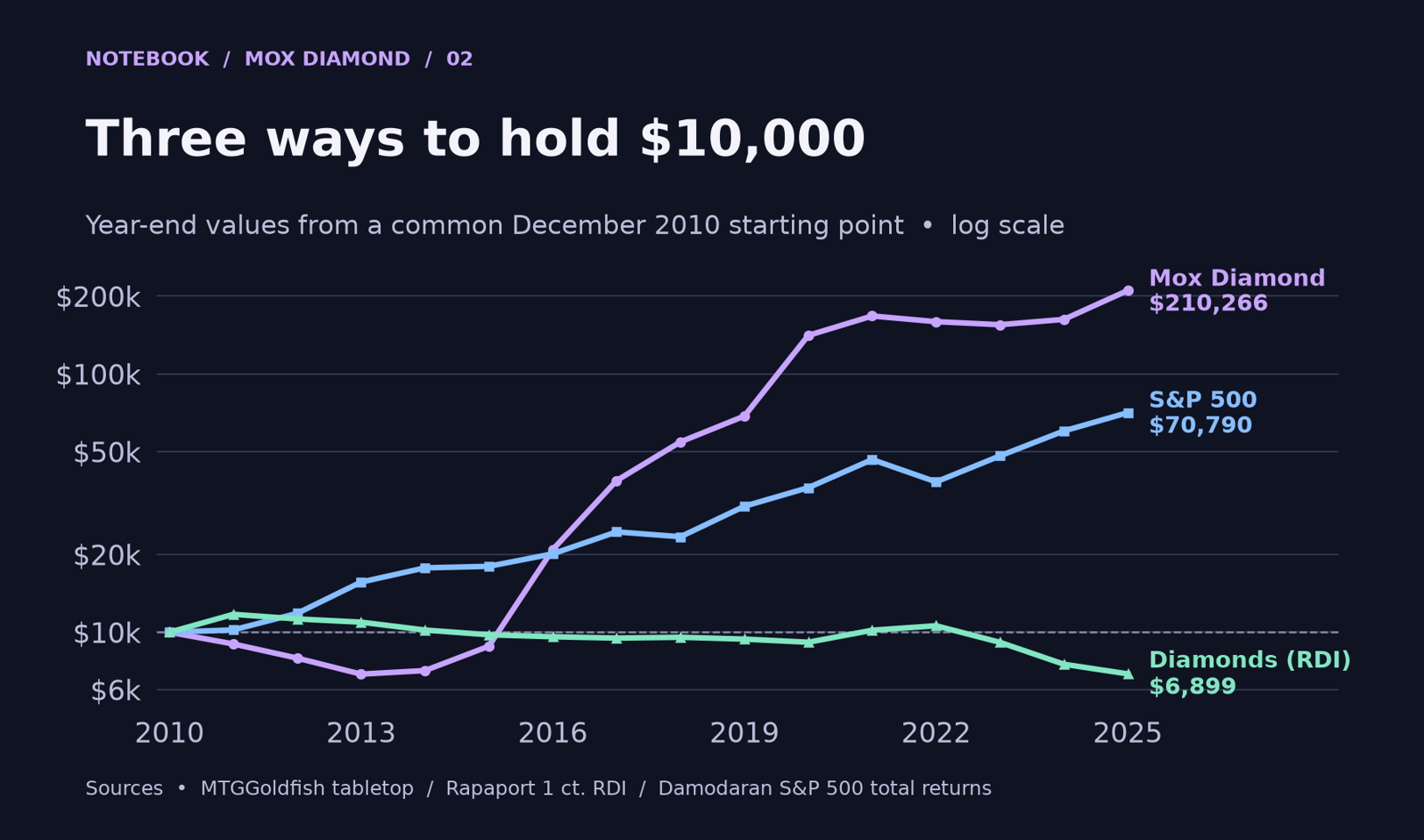
The daily Mox series starts in November 2010. For a clean comparison, I reset all three to $10,000 at the end of 2010 and used 15 calendar-year returns through 2025. The S&P 500 includes reinvested dividends. The card and diamond series measure changes in quoted prices. MTGGoldfish tabletop series · Damodaran’s annual market data
| 2011–2025 | Mox Diamond | Natural diamonds (RDI) | S&P 500 |
|---|---|---|---|
| Compound annual return | 22.5% | −2.4% | 13.9% |
| Annual volatility | 45.7% | 8.7% | 14.3% |
| Sharpe ratio | 0.59 | −0.36 | 0.95 |
| Beta to the S&P 500 | 0.16 | −0.16 | 1.00 |
Mox won on growth. The S&P 500 won on Sharpe. Mox’s annual returns swung about 3.2 times as much as the S&P’s. The annual snapshots also miss some of the drama. The daily Mox quote went from $520 in April 2018 to $200.82 in February 2019, a 61% drop from a sharp quote spike. MTGGoldfish pricing methodology
Sharpe uses the mean annual return above the three-month Treasury-bill rate proxy, divided by the sample standard deviation of those excess returns. Beta is the slope against S&P 500 excess returns. Fifteen observations leave a lot of uncertainty around the beta estimates, and a price-list index can miss the variability of actual resale prices. William Sharpe’s formula · Damodaran’s annual market data
The number on the screen
On November 4, 2026, the Mox tracker read $1,299.99, which puts the 666-card pile at about $866,000 on paper. Selling 666 copies is a different calculation. You’d need buyers, the condition of each card would matter, and you’d lose some of the headline value to fees, shipping, and the spread between asking prices and actual bids. All the comparisons above are in nominal dollars before costs. MTGGoldfish Stronghold Mox Diamond